
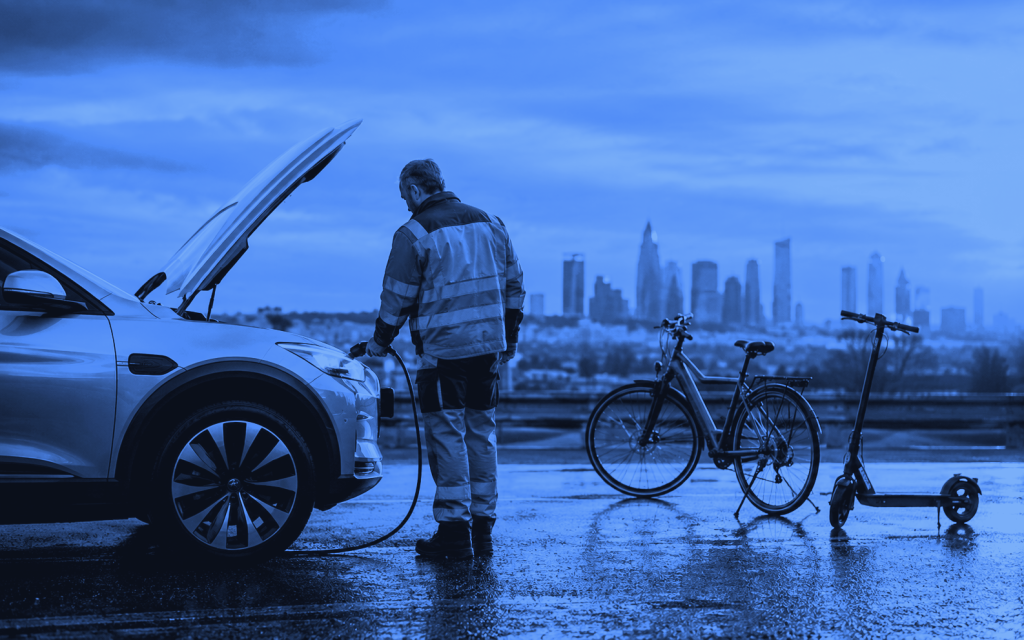
Mobility is freedom. But the way we move is changing fundamentally. A new generation is questioning car ownership, cities are becoming less car-dependent, the shift to electric drivetrains is rewriting the rules of roadside assistance, and ADAC’s members are getting older on average. What does that mean for Europe’s largest automobile club?
- 22.7 million members (end of 2025, a record)
- €482 million spent on roadside assistance (2024)
- €17 million loss at ADAC e.V. (2025)
- 42% / 77% car usage, under 30 vs. 45 and older
Mobility in transition
Wherever we live, getting from A to B is part of our personal and professional freedom. But modern mobility is no longer one-dimensional. It is a toolkit of bikes, trains, sharing services, e-scooters and, yes, our own car. The more building blocks are in play, the more often something goes wrong, and the more people need a competent partner at their side.
Change happens where three forces overlap: demographics, transport and technology. Where they meet, new habits emerge, along with new expectations of those who make mobility possible.
The most important driver is Generation Z. It stands for alternative concepts and a different understanding of mobility. Behind this are shifting values, a farewell to status thinking around expensive possessions, and the simple fact that a lot is now technically easy. What makes sense to this generation are offers that are accessible to everyone, anytime and anywhere, with as few mental and financial hurdles as possible.
There is a lot of talk about the future of mobility. The more interesting question is who will carry it and who will be left behind.
My thesis on ADAC: Roadside assistance, charging and tyre changes alone will not fund the club and its genuinely good services in the long run. It has to broaden its base. And at the same time it has to adapt better to its ageing, very loyal customer base.
Shape habits, don’t re-educate
We are all creatures of habit. Getting a middle-aged person to fundamentally change how they get around is hard work. The desire for one’s own vehicle has been deeply ingrained since the industrial revolution. That is why shared mobility struggled for a long time to reach the mainstream, even though congested metropolitan areas need it.
The lever lies less with the established than with the next generation: young adults between their mid-teens and late twenties. They often don’t own a car yet, depend on others and have limited means. They are more malleable than any other group, and they are the most affected by the industry’s upheaval. Anyone who wants to change mobility behaviour should shape it early.
This cohort already behaves differently from previous generations, including the millennials. Anyone who wants to understand the future should understand them.
What drives Generation Z
How deep the shift goes is shown by a European study from McKinsey (Mobility Consumer Pulse, more than 4,000 respondents in Germany, France and the UK, published in 2023). Only 42 percent of under-30s regularly use a private car, compared with 77 percent of those over 45. For younger people, the car is no longer the centre of things but one option among many.
Preferences are shifting too. 64 percent of Gen Z prefer compact vehicles or micromobility such as e-scooters, compared with about 50 percent in other age groups. Almost 55 percent would be willing to share their own vehicle with others. Interest in leasing packages with built-in sharing options (bikes, scooters, ride-hailing) is twice the average. And those who do buy a car increasingly choose electric: for every second young buyer in Europe, the next car is meant to be an EV.
German data paints a similar but more nuanced picture. In January 2025, only around 41 percent of 17- to 20-year-olds held a car driving licence, ten percentage points fewer than in 2015. The study “Mobilität in Deutschland 2023” shows, however, that licence holding among adults overall has barely declined. Among under-30s it is falling slightly, so the licence is partly being obtained later rather than not at all. The gap between city and countryside, on the other hand, is clear: outside cities, more than 90 percent of households own a car, in the big metropolitan areas only around 60 percent. In large cities, more than one in five households now has a car-sharing membership, almost twice as many as in 2017.
The basic pattern: away from exclusive ownership, towards flexible use. For the car, the most expensive possession in most households and long the most important status symbol, that is a shift with consequences. It is no longer a distant forecast but already measurable in how people get around.
Filling the gap
For shared mobility providers this is an opportunity. The car is no longer the precondition for freedom but one option among many, and in the city often not the most convenient one.
This creates a gap. People who travel multimodally, by bike today, in a shared car tomorrow, by train the day after, don’t need help with engine failure. They need help with the friction points of everyday life: the broken rental bike, the shared car that won’t start, the cancelled ticket, the missed connection. Whoever fills this gap will win tomorrow’s mobility customers. Which brings us to the real question of this piece.
A giant tied to the car
Hardly any organisation stands for the competent partner at the consumer’s side as much as ADAC. At the end of 2025 the club had 22.7 million members, a good quarter of Germany’s population. Around 490,000 joined in 2025, compared with about one million over the previous five years. No club in Europe comes close to this size; worldwide only the American AAA is bigger.
A look at the books shows what this giant stands on. Of roughly €930 million in membership fees (2024), the largest item by far, €482 million according to ADAC’s key figures, went into roadside assistance. The Yellow Angel jump-starting a flat battery on the hard shoulder is not folklore. It is the financial heart of the club. In 2025 the road patrol was called out 3,691,813 times, on average every nine seconds.
At the same time, costs are running away. In 2025 ADAC e.V. took in around €955 million in membership fees, €24 million more than the year before. Expenses rose by a good €42 million to almost €1.28 billion. The bottom line is a deficit of €17.1 million, after a surplus of €71 million the year before. ADAC cites higher costs for energy, staff, spare parts, towing and workshop services. A single roadside assistance call-out now costs around 27 percent more than six years ago.
The general assembly responded in May 2026 in Speyer: from 1 January 2027, fees will rise for the first time in six years. Individual members will pay €10 to €35 more per year depending on the tier; the basic membership will cost €64 instead of €54, premium €174 instead of €139. That buys breathing room, but it is not a strategy. The price lever cannot be pulled indefinitely, and cheap breakdown cover is available elsewhere too. According to “Welt”, ADAC was already internally expecting thousands of cancellations before the decision.
This is exactly where the quiet vulnerability lies. ADAC is not simply an automobile club, it is a roadside assistance club. And roadside assistance depends on three things: that people own a car, that they drive it a lot, and that its technology can be repaired at the roadside. All three are starting to wobble. Generation Z is undermining the club’s foundation, not out of ill will, but because it no longer needs it to the same extent.
The truly fascinating part: loyalty
ADAC has always interested me as a business, or more precisely as an association. Behind its size lies something almost unique in Germany: more than 22 million people who stay loyal to the club for 21 years on average. Hardly any other business model in the country has such a large, stable and trusting customer base.
This loyalty is the real asset, not the tow truck. Anyone who has the trust of a quarter of the population can sell this group far more than roadside assistance. ADAC has been going down this road for a long time: insurance, a credit card, travel, legal advice. At the 2026 general assembly it named retirement provision, health and home as new service areas; the locksmith emergency service is already running, and bicycle breakdown assistance reached 19,455 call-outs in 2025. The direction is right. So the decisive question may not be “How does ADAC save roadside assistance?” but rather: “What does it do with the trust of 22.7 million people once the car no longer holds them together?”
The loyal customer base is getting older
This loyalty has a flip side. The average member is 52 years old; as early as 2019, 50- to 69-year-olds were the largest age group and under-30s were clearly in the minority. According to the Federal Statistical Office, the share of people aged 67 and over will rise from 20 percent (2024) to around a quarter in 2035, and their number will grow to 20.5 to 21.3 million by 2038. After that come the very old: the number of over-80s will rise from 6.1 million to between 8.5 and 9.8 million by 2050. Today one in four licence holders is 65 or older; in 2015 it was about one in six.
In the short term this supports ADAC. Older members are loyal, pay reliably and call the Yellow Angels. In the long term it is a ticking clock. The baby boomers are followed by smaller cohorts, and many older people will hand over the wheel in the 2030s and 2040s. According to “Mobilität in Deutschland 2023”, today’s seniors own a car more often than previous generations, but use it much less from around age 70. Someone who is a member at 70 may no longer drive themselves at 85. Will they stay in the club?
This is a task ADAC has so far treated too little as a growth area. It rightly rejects blanket licence withdrawal based on age and offers a voluntary driving fitness check with a driving instructor. That is something to build on: explaining driver assistance systems clearly, ride services and accompaniment to the doctor when one’s own car is no longer an option, help around the house, home emergency call systems, care advice. Whoever accompanies their members from the driver’s seat via the passenger seat into everyday life without a car will not lose them when the car is sold. They will become more important to them.
Electric mobility: fewer breakdowns, different breakdowns
The drivetrain transition hits ADAC at its core competence, but differently than one might first think. The obvious suspicion is that EVs constantly break down with an empty battery. ADAC’s 2026 breakdown statistics show a different picture.
First, EVs are more reliable than combustion cars. For two-year-old vehicles, EVs have 2.1 breakdowns per 1,000 vehicles versus 5.8 for combustion cars; for five-year-old vehicles it is 10.3 versus 17.4. Second, the most common cause is an old acquaintance: the 12-volt starter battery, which is also the most frequent culprit in combustion cars. It is behind 45.4 percent of all call-outs and can be revived at the roadside with a jump-start, without towing and without mobile charging. The empty traction battery, the bogeyman of range anxiety, is a comparatively rare reason for breaking down.
For the Yellow Angels, that is good news at first. The road patrol is trained in high-voltage technology, and the most common reason for a call-out remains manageable. In 2025 ADAC was called out 50,445 times to pure EVs (around 15 percent more than the year before, but only 1.4 percent of all call-outs) and almost 60,000 times to plug-in hybrids. Mobile charging solutions for a truly empty traction battery have been tested in pilot projects.
The threat is not EV technology. That is manageable. The threat lies in three developments:
- There are fewer cars on the road overall, and they break down less often. The classic breakdown call-out, the financial heart of the club, is needed less per head.
- When something does break, it gets more complicated. A modern car is a computer on wheels. Faults increasingly sit in software and control units, and working on high-voltage systems requires a specific qualification. Many workshops still don’t dare to touch defective batteries or electric motors. Anyone who wants to solve that at the roadside needs entirely new skills.
- And the manufacturers control the data. ADAC has been calling for years for owners, independent workshops and breakdown services to get free read access to vehicle data. If remote diagnosis sits with the manufacturer and updates arrive over the air, a driver in doubt calls their brand’s hotline rather than the Yellow Angels.
Not a technological shock, but a slow drying-up of the core business.
The city is changing mobility
The third pressure point comes from the cities themselves. City centres are becoming less car-dependent: low-emission zones, parking management, closed streets, more space for cycling and walking. According to “Mobilität in Deutschland 2023”, 26 percent of all trips nationwide are made on foot and 40 percent by car as the driver. Where one’s own car used to stand at the door, a web of shared and public services is emerging, exactly the world Generation Z already moves in today.
This not only devalues car ownership, it changes the kind of help people need. For the everyday problems of multimodal mobility, the classic ADAC has so far offered hardly anything. But this is also where its greatest opportunity lies. A club with 22.7 million members, a nationwide service fleet and a trust advantage built up over decades could become the neutral caretaker for every form of mobility, across providers and modes of transport. The channel already exists: almost 700,000 breakdown reports came in via app and web in 2025, 16 percent more than the year before.
From car club to mobility club
ADAC is caught in a dilemma. Its core business, car breakdown assistance, funds the club and binds today’s members emotionally. At the same time, it is exactly what the next generation needs less and less. Costs are rising faster than revenues. Change too slowly and you age with your clientele. Move away from the car too quickly and you risk the loyal members who carry the club today.
The answer lies not in either-or, but in timing and in the right asset. ADAC’s capital is not the car, it is trust. The real value of the Yellow Angels is not the spanner but the feeling of not being alone when things go wrong. That feeling can be detached from any single mode of transport. To do so, the club needs two things at once:
- For young people, a membership that helps across bikes, sharing, public transport and travel, digital and cancellable monthly, with the same promise of security as roadside assistance.
- For older people, a club that accompanies them into old age, even long after the car has been sold.
To get there, ADAC has to open up its operating model: to partners, to revenue beyond the membership fee and to people without a car of their own. That takes speed, a willingness to experiment and the readiness to shut an offer down again. For an association with 18 regional clubs and around 240 delegates, that is no small feat. The 2027 fee increase buys time for this, perhaps five or six years.
If the transformation succeeds, the Yellow Angels will stay relevant, just no longer only on the motorway hard shoulder but wherever people are on the move. If it fails, Europe’s largest automobile club will slowly turn into the country’s largest nostalgia society.
Data sources
- ADAC key figures “Zahlen und Daten 2024”: 22,212,545 members, roadside assistance €482 million (as of 31 Dec 2024). Source of the figures in the box at the top.
- ADAC e.V., 2025 financial statements (German Bundestag lobby register): membership fees €954.7 million (2024: €930.7 million), expenses €1,275.7 million (2024: €1,233.4 million), annual result minus €17.1 million (2024: plus €71.2 million). Members 2025: 22.7 million, around 490,000 new members (ADAC general assembly 2026).
- 2027 fee increase and cost development (call-out costs up 27% since 2020): Stuttgarter Zeitung, auto motor und sport. Expected cancellations according to “Welt”: netzwelt. ADAC has not confirmed this internal expectation.
- Roadside assistance 2025: 3,691,813 call-outs, 45.4% starter battery, 50,445 call-outs to EVs, 19,455 bicycle call-outs, around 700,000 digital emergency calls (ADAC roadside assistance report 2025). Breakdown rates EV vs. combustion: ADAC breakdown statistics 2026 (auto motor und sport).
- Generation Z: McKinsey, Mobility Consumer Pulse, “Europe’s Gen Z and the future of mobility” (2023, more than 4,000 respondents in DE/FR/UK).
- Mobilität in Deutschland 2023 (infas/Federal Ministry of Transport, short report): modal split, car-free households, car sharing, licence holding. Licence share among 17- to 20-year-olds: KBA data via Statista (January 2025).
- Demographics: population projection by the Federal Statistical Office (Deutsches Ärzteblatt). Licence holders aged 65 and over: KBA data via Statista.
- Average age of 52 and average membership duration of 21 years: Autohaus on the 22 million milestone. Age distribution 2019: Statista. ADAC does not regularly publish its age structure officially.
- Data access: ADAC’s call for free read access to vehicle data, Dr. Datenschutz (2020). Driving fitness check: adac.de.
- High-voltage qualification in workshops: Stuttgarter Zeitung.